
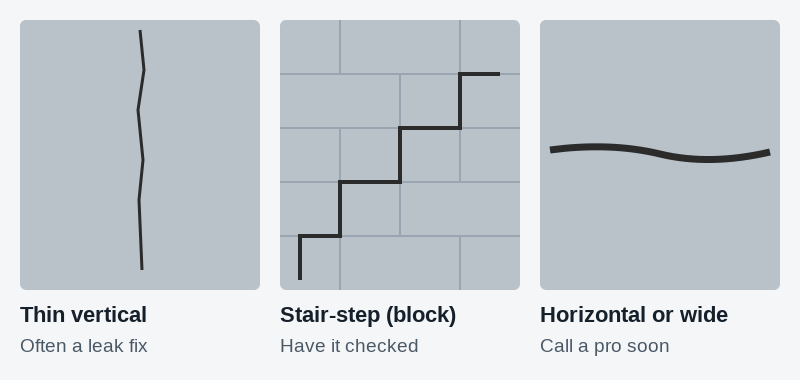
What the crack shape can tell you
- Thin, mostly straight, up and down: common in poured concrete. Usually a leak problem, not a strength problem.
- Stair-step cracks in a block wall: can mean the wall has moved. Have it looked at.
- Horizontal cracks, or a wall that bows in: can mean soil is pushing on the wall. Call a pro soon. They may bring in a structural engineer.
- Any crack wider than a coin's edge, or one that's growing: get it checked.
The usual fix: crack injection
For a leaking crack in poured concrete, a contractor often injects it from the inside with a material (epoxy or polyurethane foam) that fills the crack all the way through the wall. It's usually a few hours of work.
Typical price: $250 to $1,000 per crack (Fixr). Another guide says epoxy injection can run $800 to $1,500 per crack (Angi).
Track it while you wait
- Take a dated photo with a ruler or coin beside the crack.
- Mark the ends of the crack with a pencil. If it grows past the marks, tell your contractor.
- Note when it leaks. Only in heavy rain? That points to water pressure in the soil outside.
Sources
Get up to 3 free quotes
Takes about a minute. Free, with no obligation to hire anyone.
How a leaking wall crack gets fixed
See how water finds a crack, and how sealing it from inside stops the leak.